
By Ally Sarussi
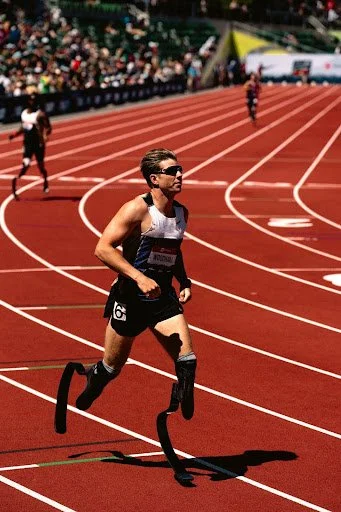
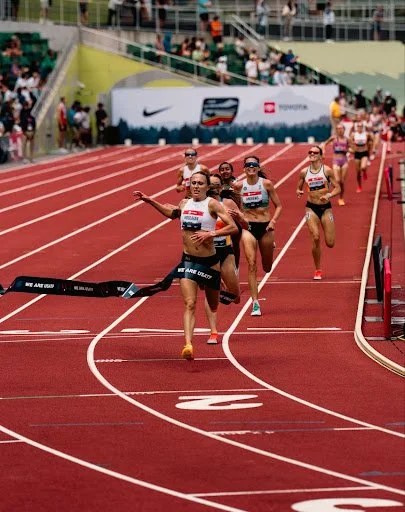
Photo credit: Suvir Grover. IG @suvirsphotos
Top photo: Paralympian Hunter Woodhall strides out after crossing the line first in the 400m T62. Bottom photo: Shelby Houlihan wins the 5000m. Both athletes will compete in their respective world championship competitions this fall.
This year at the 2025 USA Track and Field National Championships, something was different. For the first time in history, both Para athletes and athletes without physical disabilities competed at the same facility, under the same national organization, across the same three days. This collaboration also meant that in-person spectators and national TV audiences were able to see Para athletes compete and hear their stories.
While I originally was excited by the change, I quickly became frustrated at the continuous emphasis on how remarkable and “historic” it was that this event was now shared by able-bodied and Para athletes. Shouldn’t sports for all types of people be broadcasted and advertised at the same level? While we can celebrate track’s attempt at change, we should also focus on the work that needs to be done to increase non-abelist disability representation across the board.
Then my mind went to the Autistic and disabled kids I worked with as a track coach in college. This summer, were they watching people who may move or look more like themselves on a track for the first time? Has the lack of media representation of people with disabilities in sport prevented some children from seeing their potential in athletics and physical activity in general?
To begin to investigate that final question, I turned to the research. A recent survey study explored how much children with various developmental disabilities engaged in the recommended levels of physical activity, and whether this was comparable with same-age non-disabled peers. Specifically, in a 2018 report, the US Department of Health and Human Services established that school-age children should engage in at least 60 minutes of physical activity each day. The study found that only 19% of children with a disability met the recommended guidelines, noting even less participation among children with functional impairments.
There are many factors that could contribute to activity levels for children with disabilities and without: family and peer influence, access to resources and green space, and personal interests, to name a few. A systematic review highlights barriers to physical activity for people with disabilities, including social factors such as embarrassment, a lack of confidence, fear of being teased, negative attitudes of others, and lack of role models. I believe many of these factors could be changed, or at least start to be mitigated, by normalizing disability-inclusive media representation. In fact, a study in Brazil looked at the impact of exposure to media of the Paralympic Games. Kids who watched Para athletes compete in sports recognized that people with disabilities could not just be seen in terms of their impairments, but rather are capable of participating in high-level events. While these are positive impacts, it’s still important to recognize the way people with disabilities are portrayed. TV broadcasters should avoid framing athletes with disabilities as “inspiration porn,” acting just to inspire non-disabled people by “overcoming” their conditions, and instead feature them as individuals that have interests and goals just like their non-disabled peers.
As a second-year student in pursuit of a degree in physical therapy, I am learning about the importance of physical activity for overall health. Considering children with functionally-limiting disabilities are even more at risk of falling short in meeting physical activity needs, it is critical that physical therapists are prepared to encourage and support kids with disabilities, helping them make plans to be active in feasible, fun ways. In the future, I want to use my position as a health care provider to help make physical activity successful for all kids. Movement is so important; it promotes development and control of strong muscles to prevent injury, obesity, and other disease. At a young age, it also sets lifelong habits that promote wellness. However in my opinion, what is most important is how physical activity fosters social and emotional well-being. Playing games and getting involved in exercise encourages children and teens to participate in their communities, whether with family or peers. If we can use media, interpersonal connection, and an attitude of change to continue to demonstrate that sports, activity, and competition are available to everyone, I believe that kids with disabilities may be more inclined to get involved and will have more societal support when they do.
References
USATF. USA Track & Field Announces Historic 2025 USATF Para National Championships. U.S. Paralympics Track & Field. February 11, 2025. Accessed September 11, 2025. https://www.usparatf.org/news/2025/february/11/usa-track-field-announces-historic-2025-usatf-para-national-championships.
Case L, Ross S, Yun J. Physical activity guideline compliance among a national sample of children with various developmental disabilities. Disability and Health Journal. 2020;13(2):100881. doi:10.1016/j.dhjo.2019.100881
U.S. Department of Health and Human Services. Physical Activity Guidelines for Americans. 2nd ed. Washington, DC: U.S. Department of Health and Human Services; 2018.
Shields N, Synnot AJ, Barr M. Perceived barriers and facilitators to physical activity for children with disability: A systematic review. British Journal of Sports Medicine. 2011;46(14):989-997. doi:10.1136/bjsports-2011-090236
Colere J, Souza DL. Changing perspectives: Possible impacts of media related to the Paralympic Games on children’s views of disability. Sport, Education and Society. Published online January 12, 2025:1-13. doi:10.1080/13573322.2025.2451351
Young S. I’m not your inspiration, thank you very much. TED. April 2014. Accessed September 11, 2025. https://www.ted.com/talks/stella_young_i_m_not_your_inspiration_thank_you_very_much?subtitle=en.